
Seattle Voter Lookup Fields
VoteWA authenticates a registered voter with the name and birth date already on file. It is the correct first stop for checking personal registration, ballot status, voting centers, drop boxes, election dates, and county contact information. It does not let a visitor browse someone else by name.
| Lookup control | Input | Required | How it works |
|---|---|---|---|
| First name | Text | Yes | Must match the voter registration. |
| Last name | Text | Yes | Must match the voter registration. |
| Date of birth | MM/DD/YYYY | Yes | Used to authenticate the voter. |
| reCAPTCHA | Challenge | Conditional | Limits automated access. |
| Sign in | Button | Yes | Runs the identity match. |
A no-match result sends the voter to county Elections or the registration route. Multiple possible matches trigger an address choice. Once authenticated, the account can show status and election services that are not part of the public voter file.
The official VoteWA sign-in screen shows the narrow identity check used for Seattle voter registration.
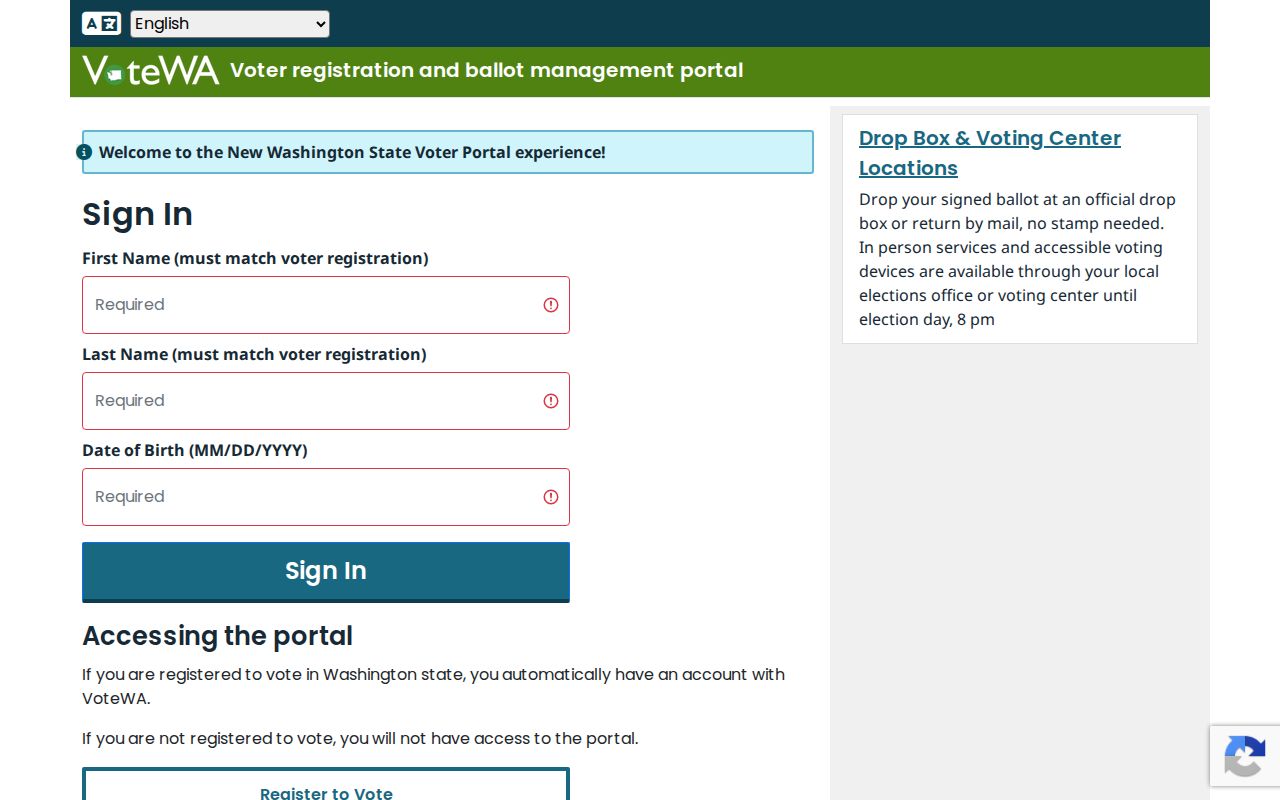
The screen’s birth-date requirement is a practical sign that the tool is a personal account gateway, not a general people directory.
VoteWA Is Not a Directory
VoteWA’s design corrects a common myth about Washington voter records. Knowing a Seattle resident’s name is not enough to open that person’s account. Registered voters receive access automatically, while an unregistered visitor cannot proceed. The account may support a replacement ballot, voter guide, ballot help, and county election contacts after the identity match.
Public voter rolls follow a separate statute and delivery process. That split protects account functions while preserving a defined group of public fields. A commercial listing that claims Washington party enrollment should be treated with care because Washington does not register voters by political party.
Seattle Voter Records That Show
RCW 29A.08.710 identifies the fields that may appear in the public registration database. These fields support election administration and civic research, but they do not open the full registration form. A record is also only a snapshot; addresses, names, and status can change after an extract is produced.
| Voter identity | Name and registration number |
|---|---|
| Geography | Address, political jurisdiction, precinct, and districts |
| Demographics | Gender and year of birth, not full birth date |
| Registration | Registration date |
| Participation | Election participation credit, never ballot choices |
These public fields can help distinguish voters with similar names or examine participation by precinct. They should not be treated as proof of current residence without confirmation from the person or the current election record.
Washington Voter Data Kept Private
The public-field list is narrow by design. Original forms, signatures, full birth dates, driver or state identification numbers, and the last four digits of a Social Security number remain confidential. The identity of a registration agency, or a person’s choice not to register through one, is also protected under RCW 29A.08.720.
In 2026, SB 5892 strengthened protection for private voter identifiers and clarified that the Secretary of State handles statewide database requests. Unauthorized disclosure by an elections officer can carry a class C felony penalty. Washington’s rules therefore distinguish a lawful public extract from confidential source records.
Get Washington Voter Records
The Washington voter database extract request provides a comprehensive active-voter snapshot with current and previous-year participation history plus district and precinct data. The delimited CSV refreshes near the start of each month and can be large enough to require database software. The current form states no set fee; law permits actual reproduction cost.
- Enter the requester’s name, email, phone, and mailing address.
- Select one offered statewide or county data file.
- Accept the use agreement covering RCW 29A.08.720, .740, and RCW 42.56.070(8).
- Submit the request and use the emailed download link after approval. Delivery is often immediate but may take up to five business days.
The file cannot lawfully be used to deliver advertisements, offers, or solicitations for money, services, or anything of value. Prohibited solicitation can be a class C felony under RCW 29A.08.740 and may also create civil liability. Questions go to vrdbextract@sos.wa.gov or 360-902-4194.
Seattle Registration Status Changes
Returned election mail can place a voter on inactive status. An address update, ballot request, or new registration restores active status. Remaining inactive through two consecutive federal general elections can lead to cancellation under the federally compatible process. Simply missing an election does not cancel a current registration.
Other changes can follow a voter’s request, a duplicate or outdated record, a disqualifying felony incarceration, an incompetence adjudication, or death. State and county officials compare death data and investigate matches rather than assuming that every similar name refers to the same person.
Washington officials report constant movement, new adult voters, deaths, and name changes. Those shifts explain why a monthly voter roll should always be labeled by its extract date.
Protected Seattle Voter Geography
Washington’s Address Confidentiality Program gives eligible survivors and other protected participants a substitute address and mail forwarding. Participants register with a special Protected Voters Registration Form and must not use VoteWA. Their actual address, name, county, and precinct receive protection from public release.
The program began in 1991 and does not erase older public records automatically. A person seeking protection works through a trained application assistant. Election research must respect that boundary and never attempt to reconstruct protected geography from other records.
Note: Washington’s general public-records framework is summarized on the Seattle public records access page, while voter disclosure follows these election-specific statutes.
King County Voter Record Help
King County Elections maintains Seattle registration and election records. Its office is at 919 SW Grady Way, Suite 100, Renton, and public hours are Monday through Thursday, 8:30 a.m. to 4:30 p.m. Voters may call 206-296-VOTE (8683), use 800-325-6165 outside the 206 area, or email elections@kingcounty.gov.
The county also handles defined election-record requests through GovQA. Public disclosure questions may go to ElectionsPDR@kingcounty.gov or 206-296-1565. A narrow request should name the record type, subject, and date range instead of asking staff to conduct broad research.
The King County Elections site provides the local service path for Seattle voter registration questions.
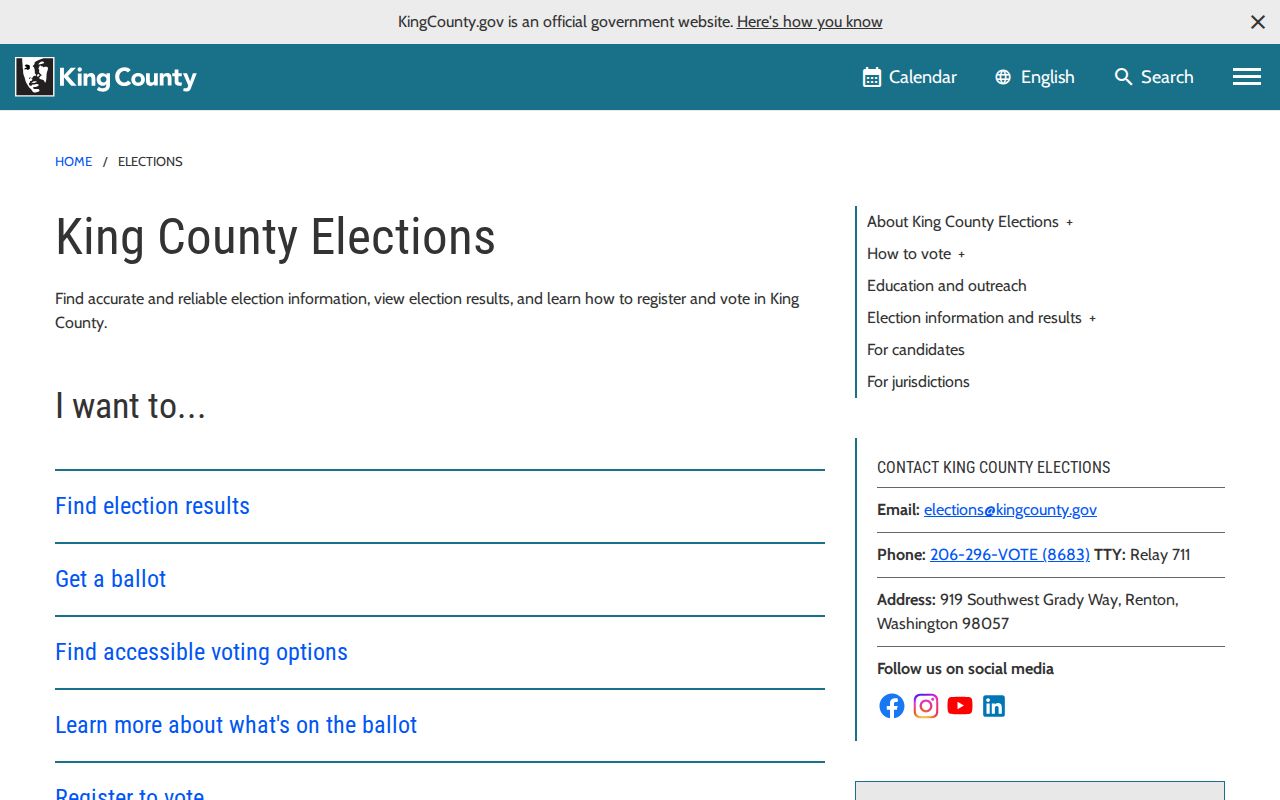
This county route matters when VoteWA returns no match, an address needs correction, or a defined elections record must be requested.
Historical Seattle Voter Registers
Historical voter work begins with a catalog search, not an assumed date range. The research did not establish a complete official run of King County poll books or registration registers. Search the Washington State Archives catalog, then ask King County Archives about election series and related county records for the relevant period.
Old Seattle geography can complicate the search. Ballard, West Seattle, Columbia, Georgetown, South Park, Ravenna, and other former towns kept distinct civic identities before annexation. A historical address may therefore point to a former municipality or county series rather than a modern Seattle label.
Pair any register with directories, censuses, and maps, but keep each source’s role clear. A city directory can place a name at an address; only the election record supports a claim about registration or participation.
Seattle Voter Challenge Records
Voter-registration challenges are a separate election record type. They are not a shortcut for browsing the voter database. Washington changed the challenge process through ESHB 1916 in 2026, and the Secretary of State published new forms on June 11 of that year. Anyone preparing or reviewing a challenge should use the current official form instead of an older saved copy.
The Washington voter registration challenge forms identify the current administrative route. A challenge asks election officials to evaluate a stated eligibility issue under election law. A similar name, returned mail, old directory entry, or address mismatch alone does not prove that a voter is improperly registered.
King County Elections remains the local contact for a Seattle voter registration question. Keep a challenge filing distinct from a request for public voter records. The first starts a defined review process. The second seeks fields that Washington law already makes public. That separation helps prevent claims based on stale extracts, changed addresses, or two people with similar names.
Election records may change while a question is pending. Check the current registration record, use exact identifying facts, and preserve the date of any extract or notice being cited. A voter challenge must never become a means to intimidate, track, or harass another person.
Lawful Seattle Voter Record Use
Washington’s voter-file agreement is more than a download notice. RCW 29A.08.720 bars using the list to mail or deliver advertisements, offers, or solicitations for money, services, or anything of value. Political purposes defined by the statute are treated differently, but a requester must still accept the stated terms before receiving the file.
RCW 29A.08.740 makes prohibited advertising or solicitation use a class C felony. It also provides civil remedies, including a stated five-dollar nuisance value for each item sent, possible fees, and joint liability in the situations the law describes. Those penalties follow the use of the voter roll, not merely the act of requesting it.
The 2026 voter-database law adds another boundary. SB 5892 can make an election officer’s unauthorized release of private identifiers a class C felony and centralizes statewide requests with the Secretary of State. Full birth dates, identification numbers, signatures, and protected addresses do not become lawful public data merely because a requester possesses a CSV.
Responsible use begins by retaining the extract date and the official agreement. Confirm a match with more than a shared name, and do not infer party preference because Washington records no party enrollment. For urgent safety concerns or suspected harassment, preserve the communication and use the proper law-enforcement or victim-support channel rather than confronting a listed voter.